Overview

Every distributed system has inherent challenges. This section consolidates the hard problems encountered in the User Service design and their solutions.

Challenge Summary

AreaChallengeSolutionTrade-off
DataEmail uniquenessGSI + conditional writesExtra query before insert
DataPrimary email invariantTransactWriteItemsTransaction overhead
DataConcurrent updatesOptimistic lockingRetry on conflict
AuthCognito-DynamoDB syncTriggers + compensationEventual consistency
AuthToken revocationShort TTL + status checkExtra DB read for sensitive ops
EventsOrderingTimestamps + idempotencyComplexity in consumers
EventsDelivery guaranteeOutbox patternAdditional infrastructure
ScaleGSI hot partitionsMonitor + shard if neededComplexity if triggered

Data Layer Challenges

Email Uniqueness

The Problem

DynamoDB has no native UNIQUE constraint. Two concurrent requests could add the same email address.
Solution: GSI + Conditional Writes
async function addEmail(userId: string, email: string): Promise<void> {
  const normalizedEmail = email.toLowerCase().trim();
  
  // Step 1: Check if email exists
  const existing = await dynamodb.query({
    TableName: TABLE_NAME,
    IndexName: 'GSI1',
    KeyConditionExpression: 'GSI1PK = :pk',
    ExpressionAttributeValues: {
      ':pk': `EMAIL#${normalizedEmail}`
    },
    Limit: 1
  });
  
  if (existing.Items?.length > 0) {
    throw new ConflictError('Email not available');
  }
  
  // Step 2: Conditional write
  await dynamodb.put({
    TableName: TABLE_NAME,
    Item: {
      PK: `USER#${userId}`,
      SK: `EMAIL#${generateId()}`,
      GSI1PK: `EMAIL#${normalizedEmail}`,
      GSI1SK: `USER#${userId}`,
      email: normalizedEmail,
      // ... other fields
    },
    ConditionExpression: 'attribute_not_exists(PK)'
  });
}
Race Condition Handling: Even with the query, a race condition exists between check and write. The conditional expression catches this:
try {
  await addEmail(userId, email);
} catch (error) {
  if (error.name === 'ConditionalCheckFailedException') {
    throw new ConflictError('Email not available');
  }
  throw error;
}

Primary Email Invariant

The Problem

Exactly one email must be primary per user. Changing primary requires updating two records atomically.
Solution: TransactWriteItems
async function setPrimaryEmail(
  userId: string, 
  newPrimaryEmailId: string,
  currentPrimaryEmailId: string
): Promise<void> {
  const newEmailItem = await getEmail(userId, newPrimaryEmailId);
  
  if (!newEmailItem.isVerified) {
    throw new BadRequestError('Email must be verified');
  }
  
  await dynamodb.transactWrite({
    TransactItems: [
      // Unset current primary
      {
        Update: {
          TableName: TABLE_NAME,
          Key: {
            PK: `USER#${userId}`,
            SK: `EMAIL#${currentPrimaryEmailId}`
          },
          UpdateExpression: 'SET isPrimary = :false',
          ExpressionAttributeValues: { ':false': false }
        }
      },
      // Set new primary
      {
        Update: {
          TableName: TABLE_NAME,
          Key: {
            PK: `USER#${userId}`,
            SK: `EMAIL#${newPrimaryEmailId}`
          },
          UpdateExpression: 'SET isPrimary = :true',
          ExpressionAttributeValues: { ':true': true },
          ConditionExpression: 'isVerified = :true'
        }
      },
      // Update user profile
      {
        Update: {
          TableName: TABLE_NAME,
          Key: {
            PK: `USER#${userId}`,
            SK: 'PROFILE'
          },
          UpdateExpression: 'SET email = :email, GSI1PK = :gsi1pk, updatedAt = :now',
          ExpressionAttributeValues: {
            ':email': newEmailItem.email,
            ':gsi1pk': `EMAIL#${newEmailItem.email}`,
            ':now': new Date().toISOString()
          }
        }
      }
    ]
  });
}
Why TransactWriteItems?
  • All-or-nothing: If any operation fails, none are applied
  • Condition checks: Can verify preconditions atomically
  • Up to 100 items per transaction

Concurrent Updates

The Problem

Two requests update the same user simultaneously, causing lost updates.
Solution: Optimistic Locking
async function updateUser(
  userId: string, 
  updates: Partial<UserProfile>,
  expectedVersion: number
): Promise<UserProfile> {
  try {
    const result = await dynamodb.update({
      TableName: TABLE_NAME,
      Key: {
        PK: `USER#${userId}`,
        SK: 'PROFILE'
      },
      UpdateExpression: `
        SET firstName = :firstName,
            lastName = :lastName,
            phone = :phone,
            version = version + :inc,
            updatedAt = :now
      `,
      ConditionExpression: 'version = :expectedVersion',
      ExpressionAttributeValues: {
        ':firstName': updates.firstName,
        ':lastName': updates.lastName,
        ':phone': updates.phone,
        ':inc': 1,
        ':expectedVersion': expectedVersion,
        ':now': new Date().toISOString()
      },
      ReturnValues: 'ALL_NEW'
    });
    
    return result.Attributes as UserProfile;
  } catch (error) {
    if (error.name === 'ConditionalCheckFailedException') {
      throw new ConflictError('Resource modified, please refresh');
    }
    throw error;
  }
}

Authentication Challenges

Cognito-DynamoDB Sync

The Problem

User registers in Cognito, but DynamoDB record creation fails. User exists in Cognito but not in application.
Solution: Post-Confirmation Trigger with Retry
export const postConfirmation = async (
  event: PostConfirmationTriggerEvent
): Promise<PostConfirmationTriggerEvent> => {
  const { sub, email } = event.request.userAttributes;
  
  const maxRetries = 3;
  let attempt = 0;
  
  while (attempt < maxRetries) {
    try {
      await createUserRecord(sub, email);
      return event;
    } catch (error) {
      attempt++;
      if (attempt === maxRetries) {
        // Log for manual intervention
        console.error('Failed to create user record', { sub, email, error });
        
        // Publish to DLQ for retry
        await sqs.sendMessage({
          QueueUrl: DLQ_URL,
          MessageBody: JSON.stringify({
            type: 'CREATE_USER_RECORD',
            payload: { sub, email }
          })
        });
      }
      await sleep(100 * Math.pow(2, attempt)); // Exponential backoff
    }
  }
  
  return event; // Must return event even on failure
};
Compensating Action: A separate Lambda processes the DLQ and retries user creation:
export const processFailedUserCreation = async (event: SQSEvent) => {
  for (const record of event.Records) {
    const { sub, email } = JSON.parse(record.body).payload;
    
    try {
      await createUserRecord(sub, email);
      // Success - message auto-deleted
    } catch (error) {
      // Return message to queue for retry
      throw error;
    }
  }
};

Token Revocation

The Problem

JWT access tokens cannot be revoked. A suspended user’s token remains valid until expiry.
Solution: Layered Defense
1

Short TTL

Access tokens expire in 1 hour, limiting exposure window
2

Status Check

For sensitive operations, verify user status in DynamoDB
3

Global Sign-Out

Invalidate all refresh tokens when user is suspended
// Middleware for sensitive operations
async function requireActiveUser(
  event: APIGatewayEvent
): Promise<void> {
  const userId = event.requestContext.authorizer.claims.sub;
  
  const user = await dynamodb.get({
    TableName: TABLE_NAME,
    Key: { PK: `USER#${userId}`, SK: 'PROFILE' },
    ProjectionExpression: 'status'
  });
  
  if (user.Item?.status !== 'active') {
    throw new ForbiddenError('Account is not active');
  }
}

// When suspending a user
async function suspendUser(userId: string): Promise<void> {
  // Update DynamoDB
  await updateUserStatus(userId, 'suspended');
  
  // Invalidate all Cognito sessions
  await cognito.adminUserGlobalSignOut({
    UserPoolId: USER_POOL_ID,
    Username: userId
  });
  
  // Publish event
  await publishEvent('user.suspended', { userId });
}

Event Layer Challenges

Event Ordering

The Problem

Events may arrive out of order. user.updated could arrive before user.created.
Solution: Timestamps + Idempotent Consumers
interface UserEvent {
  userId: string;
  timestamp: string;  // ISO8601
  eventId: string;    // For deduplication
}

async function handleUserEvent(event: UserEvent): Promise<void> {
  // Check if we've processed this event
  const processed = await isEventProcessed(event.eventId);
  if (processed) {
    console.log('Duplicate event, skipping');
    return;
  }
  
  // Get current state
  const current = await getLocalUserState(event.userId);
  
  // Ignore if we have newer data
  if (current && current.lastEventTimestamp > event.timestamp) {
    console.log('Stale event, skipping');
    return;
  }
  
  // Process event
  await updateLocalUserState(event);
  
  // Mark as processed
  await markEventProcessed(event.eventId);
}
Alternative: SQS FIFO For strict ordering requirements:
  • Use SQS FIFO queue with MessageGroupId = userId
  • Trade-off: Lower throughput (3,000 messages/second with batching)

Guaranteed Delivery

The Problem

DynamoDB write succeeds, but EventBridge publish fails. Event is lost.
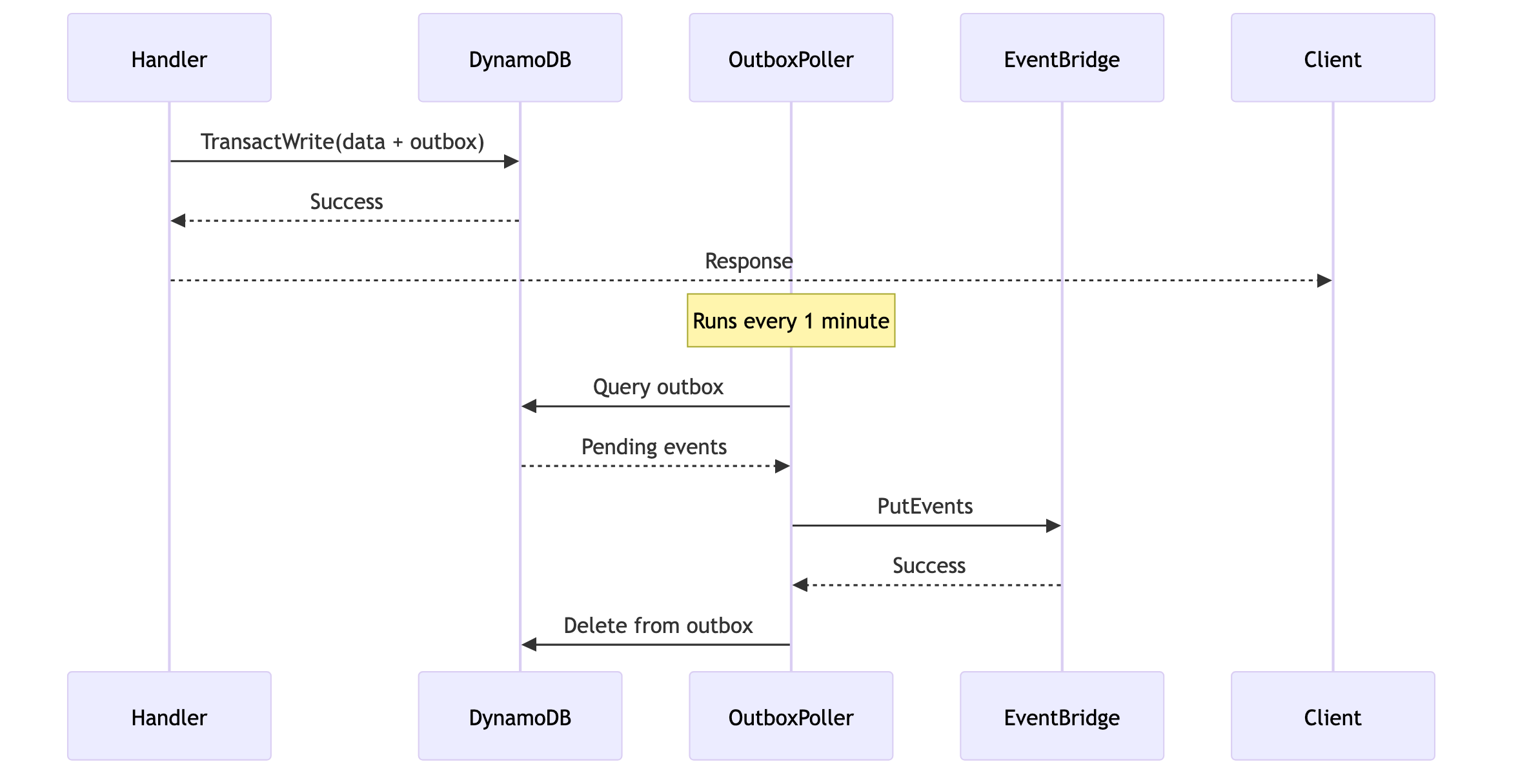
Solution: Transactional Outbox Pattern View full diagram
// In handler - atomic write
await dynamodb.transactWrite({
  TransactItems: [
    {
      Put: {
        TableName: TABLE_NAME,
        Item: updatedUser
      }
    },
    {
      Put: {
        TableName: OUTBOX_TABLE,
        Item: {
          PK: `OUTBOX#${Date.now()}`,
          SK: eventId,
          eventType: 'user.updated',
          payload: JSON.stringify(eventPayload),
          createdAt: new Date().toISOString()
        }
      }
    }
  ]
});

// Outbox poller Lambda
export const pollOutbox = async (): Promise<void> => {
  const events = await queryOutbox();
  
  for (const event of events) {
    await eventbridge.putEvents({
      Entries: [{
        Source: 'user-service',
        DetailType: event.eventType,
        Detail: event.payload,
        EventBusName: EVENT_BUS_NAME
      }]
    });
    
    await deleteFromOutbox(event.PK, event.SK);
  }
};
The outbox pattern adds complexity. Only use when event delivery is business-critical. For many use cases, at-least-once delivery with idempotent consumers is sufficient.

Failure Mode Analysis

A comprehensive view of what can go wrong, how we detect it, and how we recover.
FailureDetectionImpactRecoveryRTO
Cognito trigger failsCloudWatch Lambda errors, orphan reconciliation jobUser in Cognito but not DynamoDBDLQ retry + daily reconciliationMinutes to 24h
DynamoDB throttlingConsumedCapacity metrics, 5xx errorsAPI requests failAuto-scaling (if provisioned) or on-demand absorbsSeconds
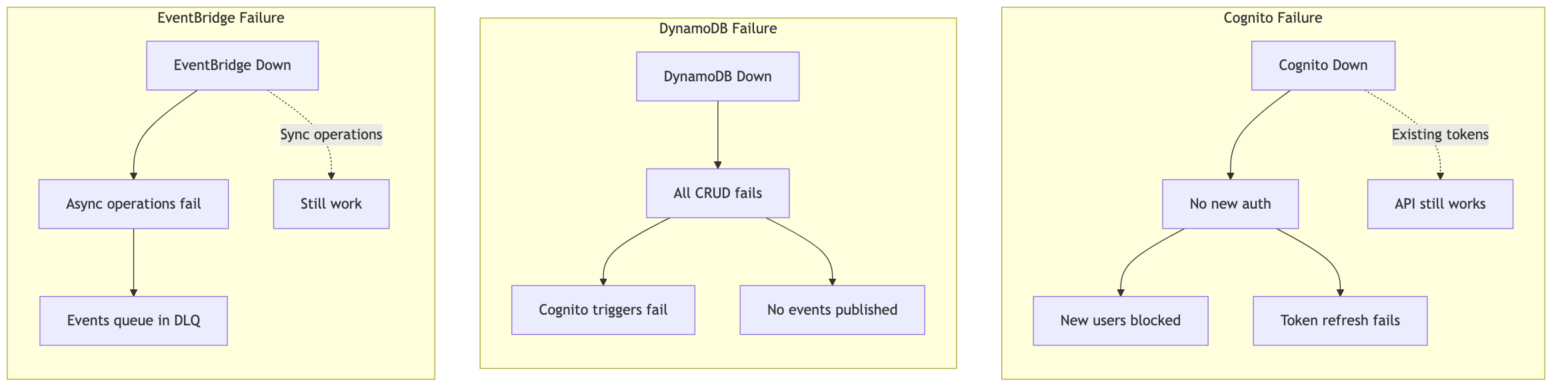
DynamoDB unavailableAPI errors, health checksFull service outageWait for AWS recovery, no manual actionAWS SLA
EventBridge delivery failsDLQ depth > 0Downstream services staleManual/automatic DLQ replayMinutes
Lambda cold start spikeDuration p99 increaseLatency spike for usersProvisioned concurrency or waitSeconds
Cognito unavailableAuth failures, 503 errorsNo new logins, existing tokens workWait for AWS recoveryAWS SLA
Concurrent update conflict409 responses, ConditionalCheckFailedUser must retryClient refresh + retryImmediate
Email uniqueness raceConditionalCheckFailed logsDuplicate prevented, user sees errorUser retries with different emailImmediate
Rate limit exceeded429 responsesUser temporarily blockedWait for window resetMinutes
Invalid JWT401 responsesRequest rejectedClient re-authenticatesImmediate

Blast Radius Analysis

View full diagram

Recovery Runbooks

Symptoms: CloudWatch alarm for DLQ depth > 0Steps:
  1. Check DLQ messages for error patterns
  2. If transient (network, throttle): Redrive messages to source queue
  3. If persistent (code bug): Fix code, deploy, then redrive
  4. Monitor for successful processing
Symptoms: Users report they registered but can’t access the appSteps:
  1. Check CloudWatch for post-confirmation trigger errors
  2. Query DynamoDB for user by Cognito sub
  3. If missing: Manually create DynamoDB record or trigger reconciliation job
  4. Investigate root cause (DynamoDB throttling, code bug)
Symptoms: Security incident requiring immediate logout of all usersSteps:
  1. Cognito: AdminUserGlobalSignOut for affected users (invalidates refresh tokens)
  2. Access tokens remain valid until expiry (1 hour)
  3. For immediate block: Deploy Lambda change to check user status on every request
  4. Consider reducing access token TTL for future incidents

What Makes This “Good”

Defense in Depth

Multiple layers of protection: JWT validation, status checks, conditional writes

Explicit Trade-offs

Each solution documents what we gain and what we sacrifice

Failure Handling

Every failure mode has a recovery path: retries, DLQ, compensation

Observable

Structured logging, tracing, and metrics at every decision point

Questions to Ask

When reviewing this design, consider:
  1. What’s the blast radius? If X fails, what else breaks?
  2. Can we recover? For every failure, is there a path back to consistency?
  3. What’s the latency impact? Extra DB reads, transaction overhead, network hops
  4. Is it worth it? Does the complexity match the business criticality?